The Life of Saint Martin · Chapter XIII
The challenge of the sacred pine: Tied up beneath the falling tree
On another occasion, in a village where he had just demolished a very ancient pagan temple, Martin was preparing to have a great pine tree that stood right beside the shrine cut down as well. This time, however, the local pagan priest and all the inhabitants came out to stop him. Incredible as it may seem, those same people who, by the will of God, had stood quietly by while the stone temple was pulled down would on no account allow the tree to be touched.
Martin tried patiently to explain to them that there was nothing divine about a wooden trunk: let them rather worship the true God whom he served, for that tree had to come down because it was consecrated to a false spirit. Until one of the villagers, bolder than the rest, threw down a challenge: “If you have that much trust in this God you say you serve, let us make a deal: we will cut down the tree ourselves, but you stand under it and catch it as it falls! If your Lord really is with you, you will escape alive!”
Without batting an eyelid and full of trust in God, Martin accepted the bargain. On hearing this, the pagans all agreed on the spot: for them, it was well worth losing their sacred tree if, in exchange, it crushed in its fall the man who was going around destroying their shrines.
Since the pine already grew leaning well over to one side, no one had the slightest doubt about the exact spot where it would fall. The villagers then tied Martin up and placed him precisely at the point they chose, right beneath the lean of the trunk. Then they took up their axes and began to cut the pine down themselves, full of enthusiasm and satisfaction. All around, a sea of people gathered to watch from a distance, holding their breath. Little by little the enormous pine began to sway and crack, on the point of coming down. Far off, the monks accompanying Martin turned white as a sheet: terror-stricken at the imminent danger, they lost all hope and even their faith, convinced that they were about to see Martin crushed to death there.
He, however, remained completely serene, surrendered into the hands of the Lord. And when the trunk cracked with a crash and at last began to topple straight towards him, about to crush him, Martin raised his hand and traced the sign of the cross in the air. At that very instant — as though a furious gust of wind had struck it head-on — the pine swung back and fell on the opposite side, almost catching beneath it the peasants who had placed themselves in the spot they thought safest!
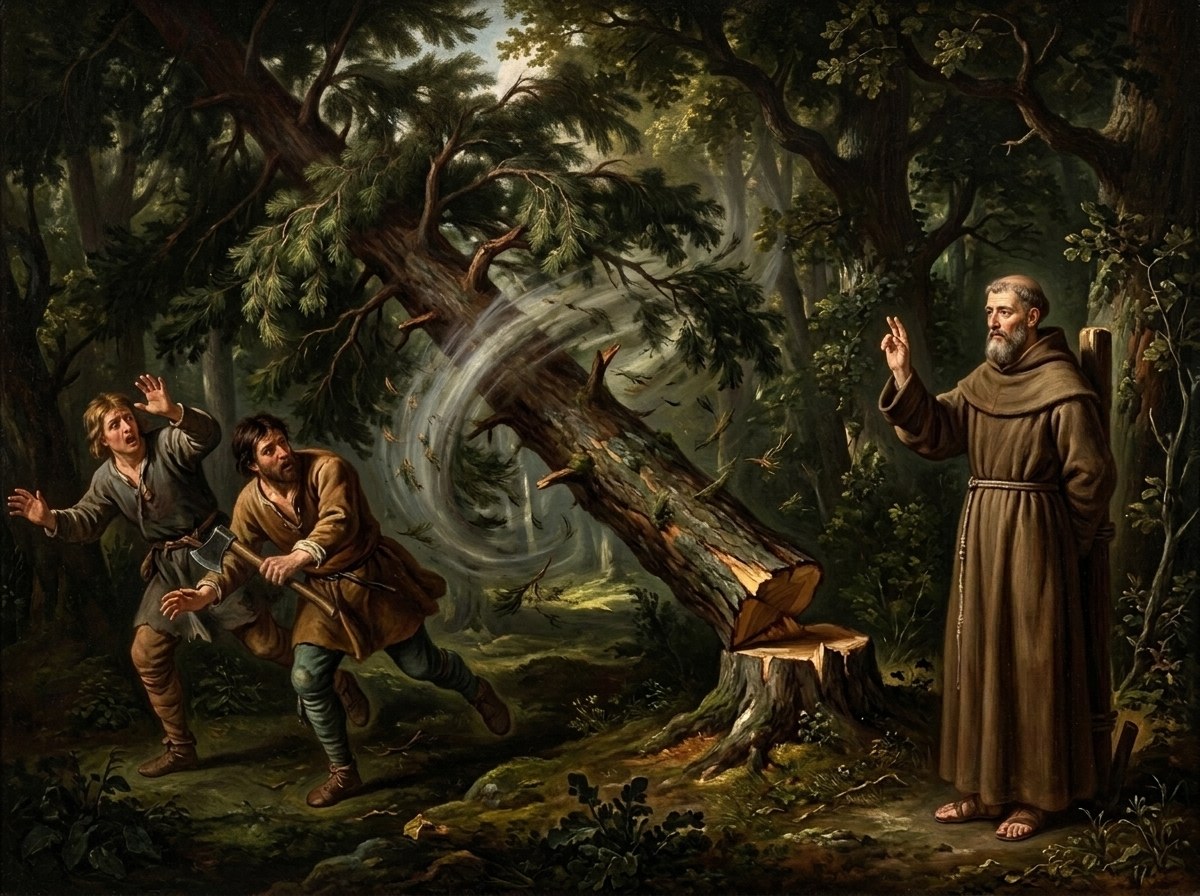
An immense shout went up at once: the pagans could not believe what they had just seen, the monks burst into tears of joy and everyone acclaimed the name of Christ with one voice. That day it became evident that the faith had won that land: in all that crowd there was hardly a single pagan who did not come and ask Martin to lay his hands on him so that he might become a catechumen, leaving the old beliefs behind to follow the Lord Jesus. The truth is that, before Martin arrived there, almost no one in that region was a Christian; but the impact of his miracles and his example was so great that today there is no village thereabouts without churches full of people or monasteries. For whenever he pulled down a pagan shrine, Martin made a point of building a church or a small monastery at once on the same spot.
Did you notice a curious detail right at the start of this chapter? The population of the village let the stone temple be demolished without reacting, but when Martin wanted to cut down the pine tree they came close to killing him! Why?
The explanation lies in the ancient religion of the Celts (the Gauls): before the arrival of the Romans, the Celts did not pray inside closed buildings; for them, the true dwelling of the gods was in centuries-old trees and sacred groves (nemora). The stone temple was no more than a fashion brought by the Romans, but that old pine was the religious soul of the village!
Notice, too, the disarming honesty of Sulpicius Severus, who does not hide the panic of Martin’s own monks, trembling in the distance, having lost “all hope and even their faith”. And notice the last sentence of the chapter: this habit of Martin’s of raising a chapel or a monastery exactly on the site of the old shrines and sacred trees lay at the origin of the network of rural parishes all over Europe!