The Life of Saint Martin · Chapter XX
The banquet of the emperor Magnus Maximus: The cup passed to the priest before the emperor
I now come to an episode that may seem smaller beside such great miracles — although, in the degraded and corrupt times we live in today, to see a bishop not bend to the flattery of the imperial court is almost a greater miracle than all the others! When a great many bishops from various provinces gathered at the court of the emperor Maximus — a hard man, full of arrogance after winning the civil war — it was pitiful to see the servile way in which they all did his bidding, lowering the dignity of bishops to the role of mere flatterers of power. Martin alone kept intact the firm bearing of an Apostle! Even when he had to ask the emperor for clemency for someone, he spoke with such authority that he seemed to be giving an order rather than asking a favour. And however often Maximus invited him to dine with him at the imperial table, Martin always refused, saying bluntly that he could not sit at the table of a man who had removed two legitimate emperors — taking the throne from one and his very life from the other.
Maximus tried to justify himself by every means: he assured him that he had not taken power out of personal ambition, but had been pushed by the soldiers, by the will of God, to govern and to defend himself by force of arms; he added that a victory as swift as his could only have the hand of God behind it, and that none of his enemies had been killed off the field of battle. He insisted so much, between justifications and entreaties, that Martin ended up agreeing to go to the dinner — leaving the emperor overjoyed at having finally persuaded him.
The banquet looked like a great feast day and brought the greatest figures of the Empire together at table: Evodius was there, prefect and consul at the same time, one of the most just men who ever lived; and there were also two counts with the very highest military powers, who were the emperor’s brother and his paternal uncle. Between these last two they seated the priest who was accompanying Martin; Martin himself was seated on a low stool placed right beside the emperor’s place.
Halfway through the dinner, as court protocol required, the cup-bearer brought a cup of wine to the emperor. Full of deference, Maximus ordered it to be taken first to the holy bishop, for he was most anxious then to receive the cup directly from Martin’s hands. Only Martin, after taking a sip, held the cup out to the priest who had come with him! He judged that no one in that room had greater dignity to drink straight after a bishop, and that he would betray his conscience if he put the emperor himself or his relatives ahead of a priest.
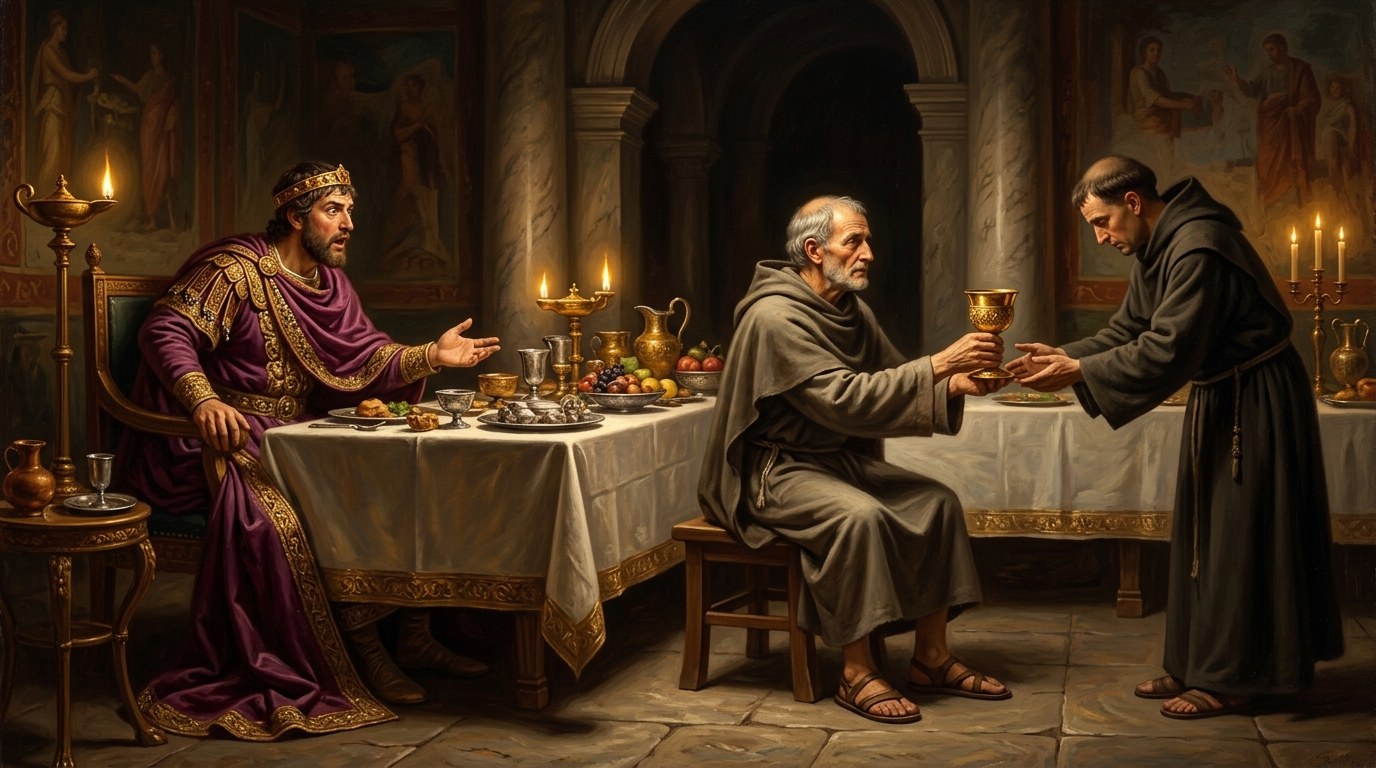
Incredible as it may seem, both the emperor and all the guests were so impressed by that freedom of spirit that they liked the very gesture that had pushed them into second place! In a short time nothing else was talked of in the whole palace: at the emperor’s own table, Martin had had the courage to do what no other bishop dared to do even at the dinners of second-rank governors.
Later, and long before war broke out, Martin warned that same Maximus of what would happen to him if he went ahead with his plan to invade Italy and attack the young emperor Valentinian: he would win the first battle against him, but would die a short time afterwards. And that is exactly what we ourselves saw happen: as soon as Maximus entered Italy, Valentinian had to flee; but after about a year he reorganised his army, besieged Maximus within the walls of Aquileia, captured him and had him executed.
Set in the imperial palace at Trier around 385 or 386, this scene is one of the most celebrated moments in the relationship between political power and the Church in Antiquity:
1. Who were the “two emperors” Martin spoke of? Magnus Maximus was a general born in Hispania and proclaimed emperor by the troops of Britain in 383. He crossed the English Channel, defeated and had killed the young legitimate emperor Gratian (from whom he took his life) and put pressure on his half-brother, the adolescent Valentinian II (from whom he took part of the Empire). All the figures seated at the table are historical: Flavius Evodius was Praetorian Prefect of Gaul and Roman Consul in the year 386.
2. The scandal of the cup (patera): Under the rigid rules of the imperial court, to drink first from the Emperor’s cup and hand it back to him in person was the greatest distinction a guest could receive. By passing the cup to his simple priest (presbyter), over the heads of the Emperor, the Consul and the imperial Counts, Martin affirmed without saying a word that the things of the spirit do not bow before military or political power.
3. What had Martin gone to Maximus’s court to do? From another book by Sulpicius Severus (the Chronicle), we know that Martin had gone to Trier to try to save from death the Hispanic bishop Priscillian and his disciples, accused of heresy by other scheming bishops — fighting to the limit to prevent the State from executing people over religious questions.