The Life of Saint Martin · Introduction
The Narrator’s Opening Note: The Man behind the Legend
Across much of Europe, the 11th of November only has to come round for the name of Saint Martin to return to everyday conversation, bringing with it the smell of roasted chestnuts, the new wine, the lantern processions and those mild, sunny, out-of-season days that so many peoples call “Saint Martin’s Summer”. Almost everyone knows the image of the young Roman soldier on horseback who, on a freezing winter’s day, cut his cloak in two with his sword to wrap up a beggar shivering with cold.
What few people know is that Saint Martin of Tours (c. 316/336 – 397 AD) is no hazy figure out of medieval legend. On the contrary: he is one of the best-documented personalities of the late Roman Empire. His biography — The Life of Saint Martin (De vita beati Martini) — was written while he was still alive, by a man who knew him personally, ate at his table and talked with him at length: Sulpicius Severus.
Sulpicius Severus (c. 363 – c. 425) was a brilliant lawyer, a renowned orator and an aristocrat from Aquitaine, in the south-west of what is now France. When he decided to write this book, around 396, the Western Roman Empire was going through a profound change. Christianity had ceased to be a persecuted religion and had become the official faith of the emperors; in the cities, influential bishops were multiplying, dressed in silk and used to dining at court, while in the villages of the countryside (pagi) the rural population went on venerating sacred trees and the old Celto-Roman gods.
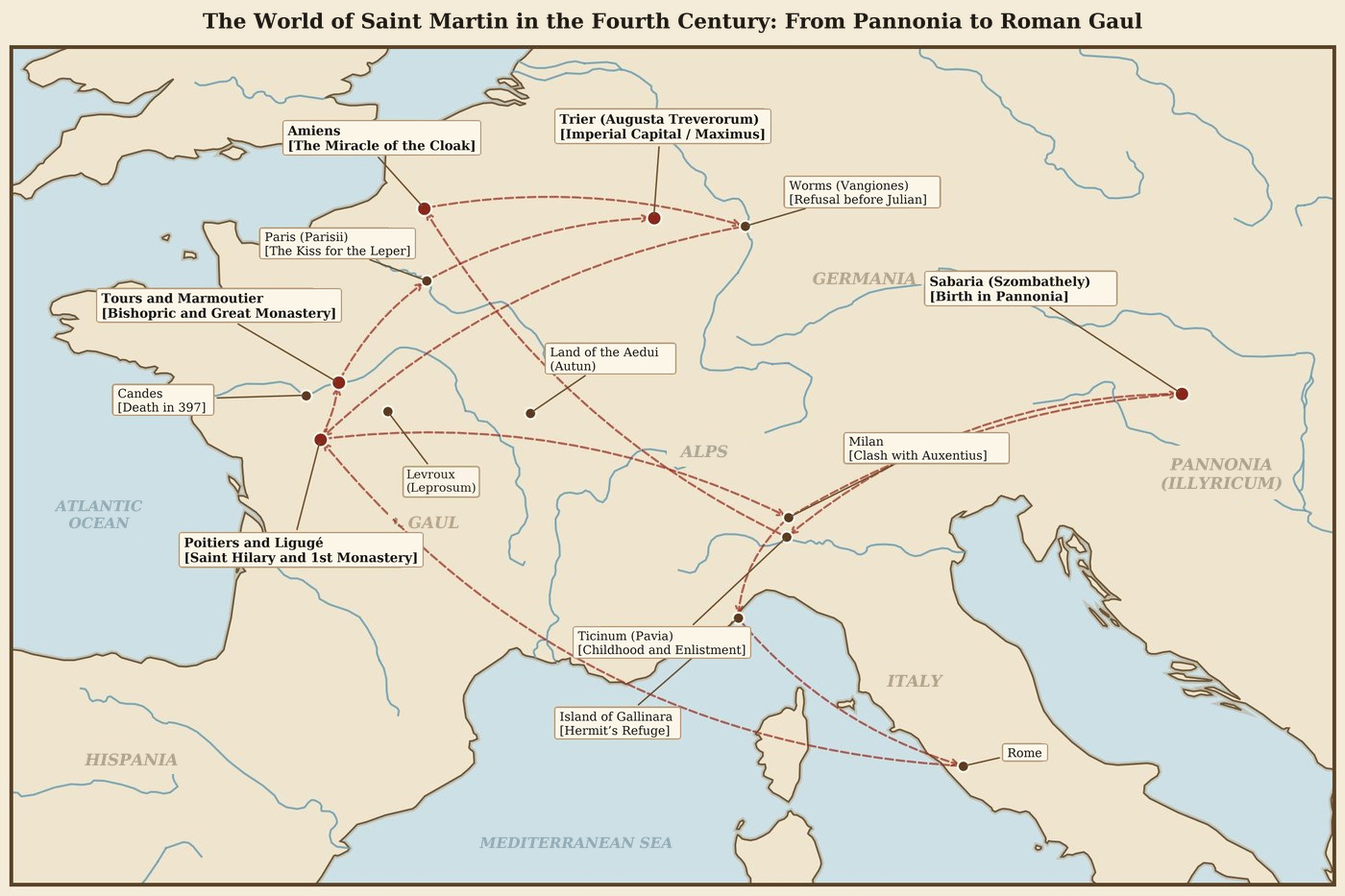
In the middle of that changing world, Martin was a real scandal to the elites: a former officer of the imperial guard who refused to fight, face to face with the future emperor Julian; who was tricked by the people into being carried off to become bishop of Tours, yet never agreed to live in a bishop’s palace, preferring a wooden hut and a rough tunic of camel hair. He was a man who kissed lepers at the gates of Paris, stood up to emperors in Trier, unmasked charlatans and went so far as to shock the strictest theologians by saying that even the Devil himself would be forgiven by God if he were capable of repenting.
In this edition, the complete text of Sulpicius Severus has been rewritten in clear, natural, contemporary English, faithfully keeping every episode and detail of the Latin original. At the end of each chapter, I join you as narrator to explain Roman military customs, the geography of the period, the political background and the culture of the fourth century — details that were obvious to readers in Sulpicius’s day, but which now help us enormously to grasp the extraordinary force of this story.