The Life of Saint Martin · Chapter IV
Face to face with Julian at Worms: “I am a soldier of Christ; I cannot fight”
Meanwhile, the barbarian peoples invaded Gaul. The Caesar Julian then gathered his army near the city of the Vangiones and began to distribute a special cash bounty to the soldiers. As was the custom, the men were called up one by one by name, until it came to Martin’s turn.
Realising that this was the right moment to ask for his discharge from the army — not least because he thought it dishonest to accept the money knowing that he was not going into combat — Martin spoke directly to Julian: “Until today I have been in your service; let me now serve God. Let the man who is going into battle keep your bounty; I am a soldier of Christ, I cannot fight.”
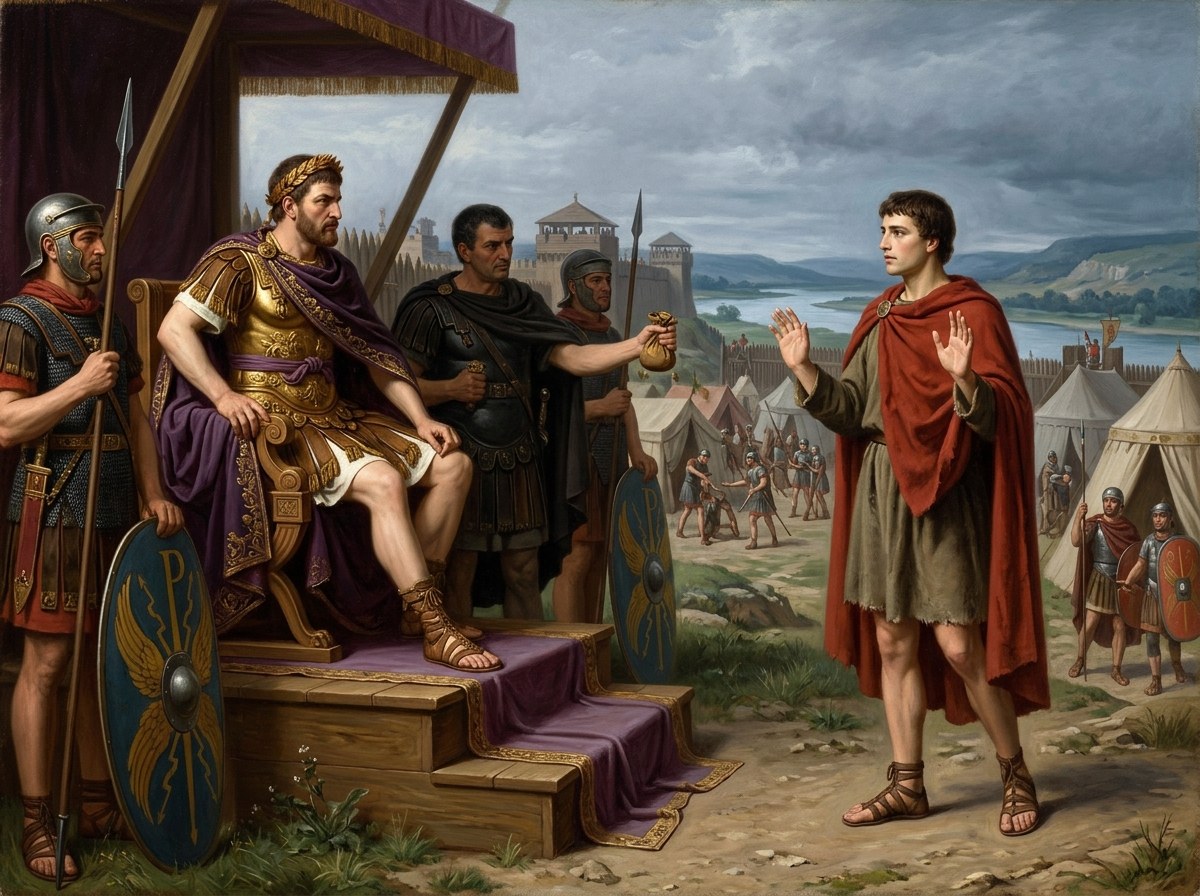
On hearing this, the tyrant flew into a rage and threw it in his face that it was not out of faith that he wanted to leave the army, but out of fear of the battle set for the following day. Martin, refusing to be intimidated — and indeed growing firmer in the face of those threats — answered him: “If you think this is cowardice and not faith, tomorrow I will present myself unarmed in the front rank, ahead of our troops; and in the name of the Lord Jesus, with neither shield nor helmet, protected only by the sign of the cross, I will advance without fear through the midst of the enemy lines.”
Julian had him arrested at once, to force him to keep his word the next day, facing the barbarians and unarmed. But first thing in the morning the enemy sent envoys to sue for peace, surrendering unconditionally and handing over everything they had.
In view of this, who can doubt that the victory was due to Martin, spared in this way by God from being thrown unarmed into the front line? Of course the Lord, in His goodness, could perfectly well have kept His soldier safe and sound amid the enemy’s swords and spears; but He chose to avert the battle itself, so that Martin’s eyes should not even have to witness the death of other men. After all, what other victory would Christ give His soldier but this: to defeat the enemy without shedding a drop of blood and without anyone dying?
We are in the year 356 AD, at Borbetomagus, the city of the people of the Vangiones — present-day Worms, on the banks of the river Rhine, in Germany. Germanic tribes (Alamanni and Franks) had crossed the Rhine and sacked several cities in Gaul.
At the head of the Roman troops is Julian Caesar, nephew of Constantine, who a few years later would become emperor and go down in history as Julian the Apostate (361–363), for having tried to restore paganism in the Roman Empire and strip Christians of their privileges — which is why Sulpicius harshly calls him “the tyrant” (tyrannus).
To measure Martin’s courage, it helps to understand what this military bounty (donativum) was: on top of the normal pay (stipendium), on the eve of an important campaign the commander handed a generous sum in gold coins to each soldier in person. Accepting the donativum amounted to renewing one’s pledge of honour to fight to the death in the coming battle. Had Martin taken the gold and then refused to take up his sword, he would have been executed for desertion and theft; by refusing the money in public, with the whole army drawn up on parade, he openly defied Julian’s authority, in one of the most celebrated cases of conscientious objection in Antiquity.