The Life of Saint Martin · Chapter VII
The monastery of Ligugé and the first miracle: The catechumen who came back to life
Since Hilary had already passed through Rome by the time he got there, Martin followed in his footsteps to Poitiers. Hilary welcomed him with immense joy, and shortly afterwards Martin founded a small monastery on the outskirts of the city. Before long he was joined by a young catechumen who wanted to learn to live under the guidance of so admired a master; but after a few days the young man took to his bed with a raging fever.
Unfortunately, Martin had had to go away on a journey and was absent for three days. When he came back, he found him already dead: the illness had been so sudden that the young man had gone without even having had time to be baptised. The body was laid out in the middle of the room, surrounded by the monks in tears as they prepared the funeral, when Martin came running in, weeping bitterly.
Guided by a deep inner inspiration, he asked everyone to leave the little cell where the body lay, locked the door from the inside and stretched himself out on the lifeless brother. He remained like that, praying intensely, for some time, until he felt, in the depths of his soul, that the power of God was at work. Then he raised himself a little and kept his eyes fixed on the young man’s face, waiting, full of confidence, for the fruit of his prayer and of the Lord’s mercy. Not two hours had passed when he saw the whole body begin, very slowly, to stir and the eyelids to tremble, opening once more to the light. Deeply moved, Martin burst out thanking God in so loud a voice that the cries of joy filled the whole cell. Hearing this, the monks who were waiting outside by the door rushed straight in — and were left speechless at seeing alive the one they had left dead!
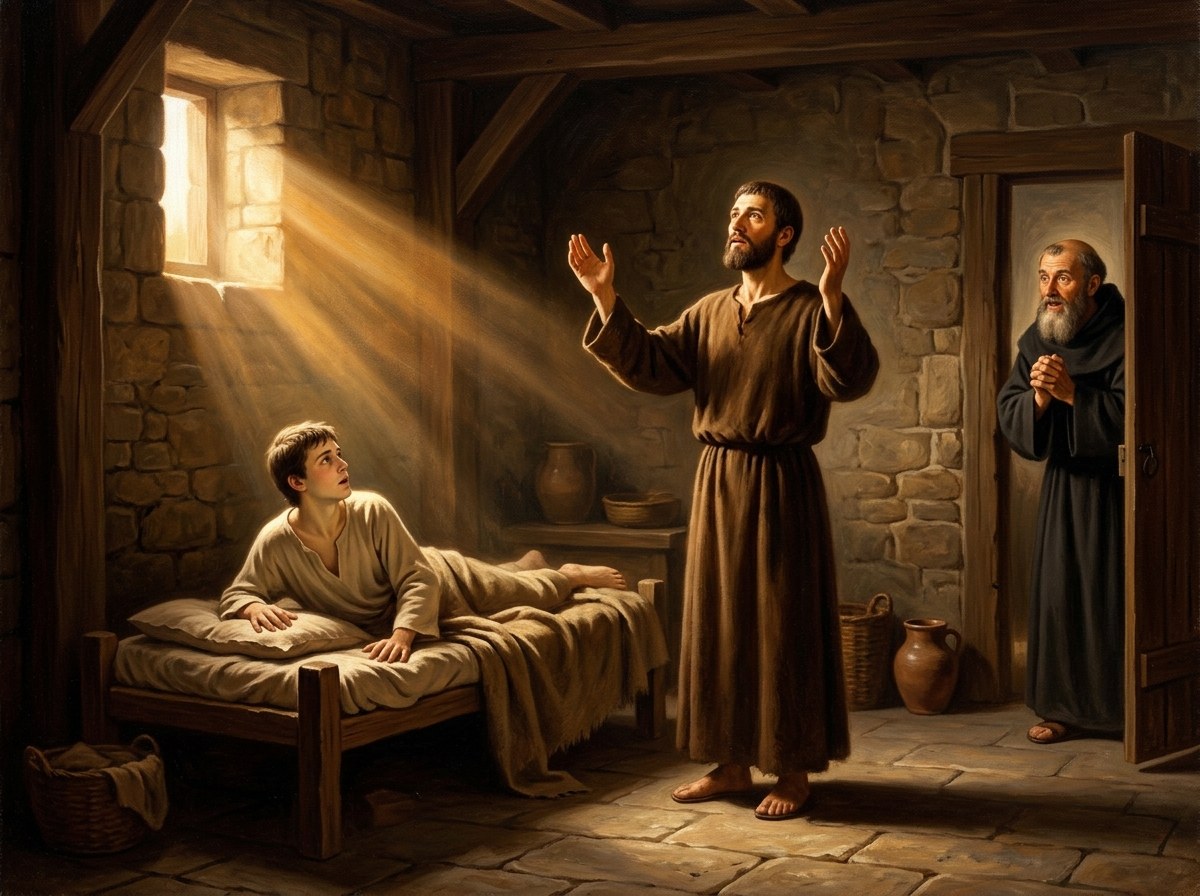
Restored to life, the young man was baptised straight away and lived for many years more, becoming among us the first living witness to Martin’s miracles. He himself used to tell what had happened to him after he left his body: he had been led into the presence of the supreme Judge and, since he was not yet baptised, had just heard the harsh sentence sending him to a gloomy place amid a nameless crowd. At that instant, however, two angels informed the Judge that this was the very young man for whom Martin was praying. By order of the Judge, the same angels brought him back, handed him over to Martin and restored him to life. From that day on, Martin’s fame spread everywhere: the man whom everyone already regarded as holy came to be admired also for the power of his wonders and compared to the Apostles themselves.
The small community that Martin created near Poitiers around 361 is Ligugé — considered by historians to be the oldest monastery in Western Europe, founded more than a century and a half before Saint Benedict!
Notice two curious details in this episode:
1. The gesture of the ancient prophets: When Martin shuts the door of the room and lies down on the dead young man, he is repeating exactly the gesture of the prophets Elijah (1 Kings 17:21) and Elisha (2 Kings 4:34) in the Old Testament.
2. The fear of dying unbaptised: Why does the young man say that he was about to be sent to a “gloomy place” (obscuris locis)? For fourth-century Christians, to die while still a catechumen, before baptism, left the soul deprived of full entry into the light — and this description is also one of the oldest accounts in Western literature of what we would today call a near-death experience.