The Life of Saint Martin · Chapter III
The cloak cut in two at the gates of Amiens and the vision of Christ
Once, at a time when he had nothing left with him but his weapons and a simple military cloak, in the middle of a winter far harsher than usual — with a cold so fierce that many people were freezing to death in the streets — Martin came across a poor man, completely naked, at the gates of the city of Amiens. The beggar was asking passers-by to take pity on him, but everyone walked on without paying him the slightest attention. That young man full of faith understood at once that, if no one else was coming to the wretch’s aid, God had left him in his care.
But what could he do? He had nothing left but the military cloak he was wearing, because he had given everything else away to others in need. So he drew the sword he wore at his waist, cut the cloak exactly in half, gave one half to the poor man and put the remaining piece back over his shoulders. Around him, some of those watching the scene burst out laughing, finding the figure of a soldier with half his cloak cut away ridiculous; many others, however, with more conscience, felt deeply ashamed at not having done anything of the kind, when they had more than enough means to clothe that man without going cold themselves.
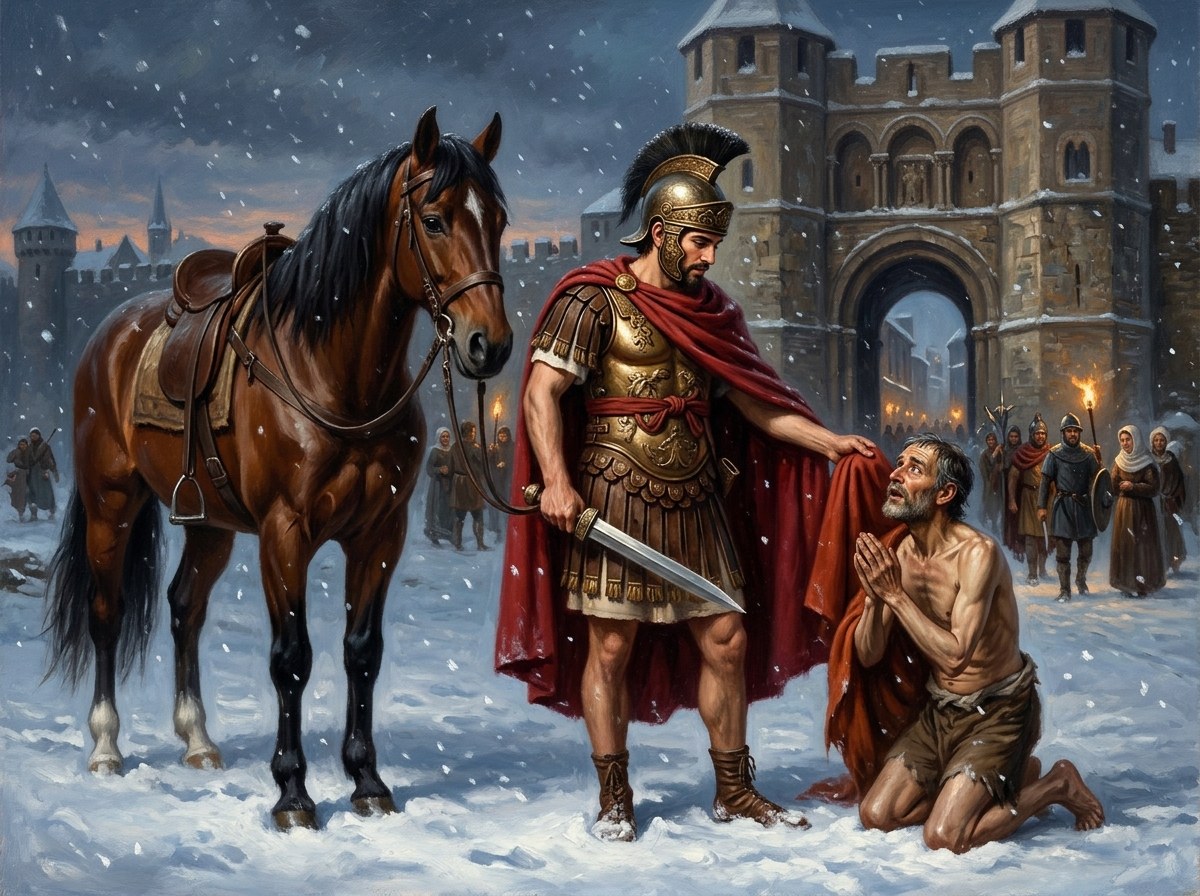
The following night, after falling asleep, Martin saw Christ in a dream, dressed in the very half of the cloak he had given the beggar. He felt he was being asked to look closely at the Lord and to recognise the garment he had given away. Straight afterwards he heard Jesus say in a clear voice to the multitude of angels around him: “Martin, who is still only a catechumen, has clothed me with this cloak!”
True to the words He Himself had spoken in the Gospel — “Whenever you did this to one of the least of these my brothers, you did it to me” — the Lord was showing in this way that it was He Himself who had been wrapped up in the person of that poor man; and, to confirm the worth of that gesture, He chose to appear dressed in the exact piece of cloth the beggar had received. In spite of this vision, Martin did not become full of vanity. On the contrary: recognising in all this the goodness of God, as soon as he turned eighteen he hastened to be baptised. Even so, he did not leave the army at once, because he gave in to the insistent pleas of his tribune, who was a close friend and tent-mate of his; for this commander promised him that, as soon as his own term of military service was over, he too would leave the life of the world. Holding on to that promise, Martin stayed in the army for almost two more years after his baptism, though by then he was a soldier in name only.
We have just read the most famous episode in the life of Saint Martin, which took place at the gates of Samarobriva Ambianorum — the present-day city of Amiens, in northern France — during a freezing winter in the 330s or the 350s. Three curious facts bring this scene even more to life:
1. Why did Martin cut the cloak in half instead of giving the whole of it? In the Roman imperial guard, the white or scarlet military cloak (chlamys, often lined with sheepskin in winter) was part of the regulation uniform: half belonged to the Roman State and the other half was paid for by the soldier. If a soldier turned up on parade with no cloak at all, he was punished for losing equipment! By cutting it in half with his sword, Martin gave away everything that was his and kept the compulsory part — and was left looking so comical (truncatus habitu) that passers-by laughed.
2. How Martin’s half-cloak gave rise to the words “chapel” and “chaplain”: Centuries later, this half-cloak of Saint Martin (called in late Latin the cappa, “little cloak”) became the most precious relic of the Frankish kings, who even took it into battle with them. The small shrine where they kept Saint Martin’s cappa came to be called the capella (“the place of the little cloak”), and the priests charged with looking after it were the capellani. That is the direct origin of the words chapel and chaplain!
3. And “Saint Martin’s Summer”? As you can see from Sulpicius Severus’s original text, in the fourth century there was as yet no legend of the sun breaking through the clouds at that moment. That popular tradition arose centuries later, when the feast of Saint Martin’s funeral (on 11 November) came to coincide with the usual weather pattern of mid-November — a run of days of warm sun and clear skies before winter — joining for ever the human warmth of the gesture of the cloak to the autumn sun.