The Life of Saint Martin · Narrator’s Epilogue
What happened next: The death of Saint Martin and the origin of the 11th of November
Why does Sulpicius Severus’s book end without telling of the death of Saint Martin? For the simplest reason of all: when the manuscript was finished and went off to Desiderius’s house, in the spring or summer of 397, Martin was still walking the roads of Gaul.
The end of his journey, however, was just around the corner — and it was Sulpicius Severus himself who told of it shortly afterwards in three unforgettable letters (the Letters to Eusebius, to the deacon Aurelius and to his mother-in-law Bassula).
At the end of October or in the first days of November of that same year 397, already very worn by the years, Martin learned that the priests of the parish of Candes (today Candes-Saint-Martin, where the river Vienne flows into the Loire) were at odds with one another. True to his principle of never leaving a conflict unhealed, he set out at once to make peace between them.
After managing to reconcile the clergy of Candes, as he was preparing to return to his beloved monastery of Marmoutier, he suddenly felt his strength fail him, struck down by a very high fever. His disciples gathered round his pallet bathed in tears: “Father, why are you leaving us? To whom are you entrusting us, orphans as we shall be? Ravening wolves will fall upon your flock!” Torn between the wish to depart at last to God and sorrow at leaving his monks unprotected, Martin then spoke one of the most famous sentences of his life: “Lord, if your people still need me, I do not refuse the work (non recuso laborem); your will be done.”
In the last days of the fever, he would not even allow a simple straw mattress to be put under his body: he insisted on dying stretched out on his back on the ground, on a layer of ashes and a rough penitential tunic, saying to his disciples: “A Christian should not die otherwise than on ashes.” When the priests wanted to turn him a little on his side to ease the pains of his body, he asked them: “Let me be, brothers, let me go on looking at heaven rather than at earth, so that my spirit may already be getting used to the road it is going to take to the Lord.” In his very last moments, sensing the presence of the Devil standing beside him, he confronted him for the last time: “What are you doing here, cruel beast? You will find nothing of yours in me, accursed one: I am going to be welcomed into the arms of Abraham!” And so he departed in peace, on 8 November 397.
The body was taken by boat up the river Loire to the city of Tours, accompanied by a crowd such as had never been seen — Sulpicius tells us that the monks alone numbered close to two thousand, besides countless consecrated women and the entire populations of the towns and villages, who walked along the banks singing psalms as the boat passed.
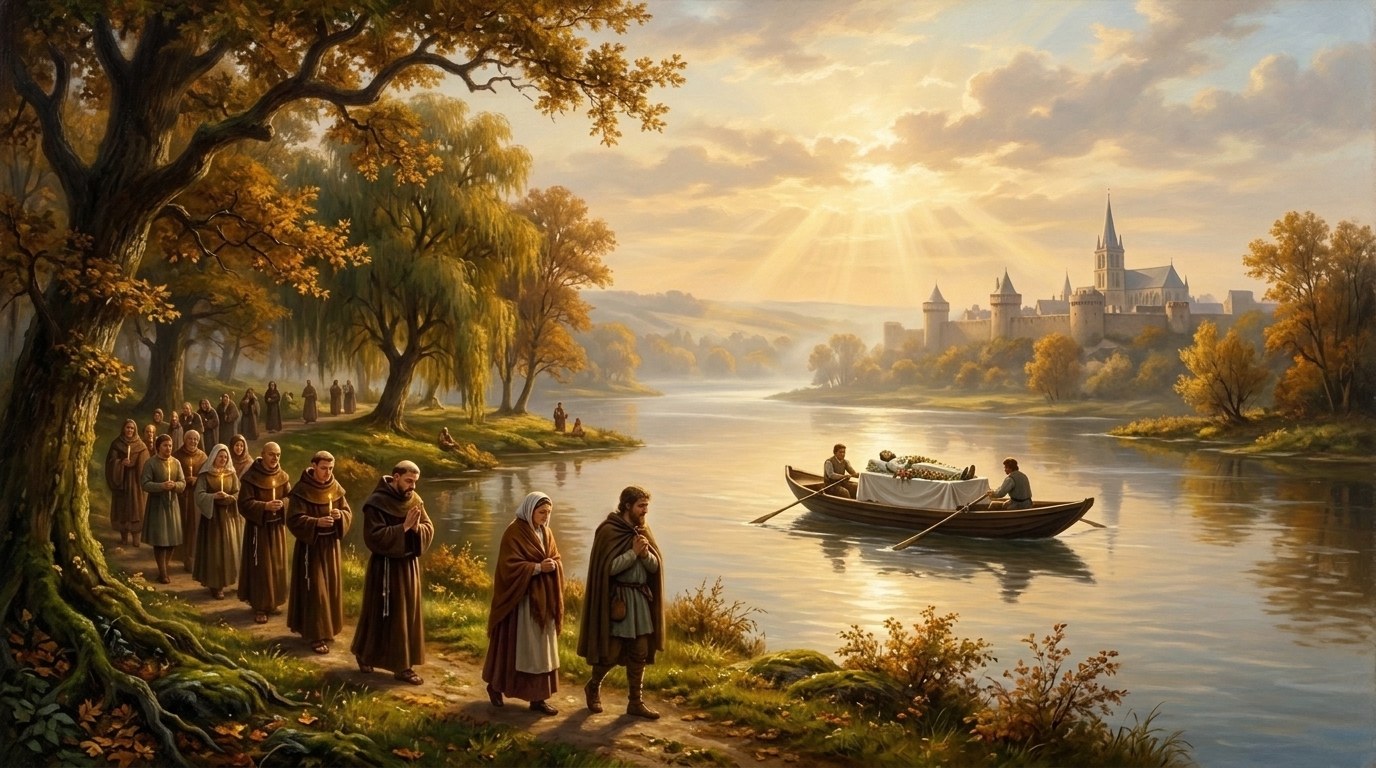
The solemn burial in Tours took place three days later, on 11 November 397. It was exactly that date — the day when Martin’s body was laid in the earth on the threshold of the European winter, at the time when work in the fields was coming to an end, the new wine was being tasted in the cellars and the season’s chestnuts were being roasted — that was engraved for ever in the memory of the whole of Europe as Saint Martin’s Day.